




Stay informed about the latest updates
25
2024
-
09
Lebanon Crisis: Solar Panels Explode in Multiple Locations—What Is the Real Story?
Author:
Following the pager explosions that occurred in multiple locations across Lebanon on September 17, additional explosions involving communication equipment were reported in several parts of the country on the afternoon of September 18, local time. According to CCTV’s report on the afternoon of the 18th, multiple blasts took place in Beirut, the capital; Marjayoun in the southeast; the eastern Bekaa Valley; and other areas, with the devices targeted including pagers, walkie-talkies, and various wireless communication equipment.
Written by | Penn
Editor | Tang
→ This is the 1,229th original article from Global Zero Carbon.
Following the pager explosions that occurred in multiple locations across Lebanon on September 17, additional explosions involving communication equipment were reported in several parts of the country on the afternoon of September 18, local time. According to CCTV’s report on the afternoon of the 18th, multiple blasts took place in Beirut, the capital; Marjayoun in the southeast; the Bekaa Valley in the east; and other areas, with the devices targeted including pagers, walkie-talkies, and various wireless communication equipment.
According to a report by Xinhua News Agency, Lebanese Public Health Minister Firas Abiad stated at a press conference on the 19th that the explosions of communication equipment that occurred in Lebanon on the 17th and 18th have resulted in 37 deaths and 2,931 injuries. According to the latest figures released, the explosion on the 17th caused 12 deaths and 2,323 injuries, while the explosion on the 18th led to 25 deaths and 608 injuries.
According to a report by the National News Agency (NNA) of Lebanon, Following a series of pager explosions the previous day, solar panels and walkie-talkies used by the Hezbollah militant organization also exploded on September 18.
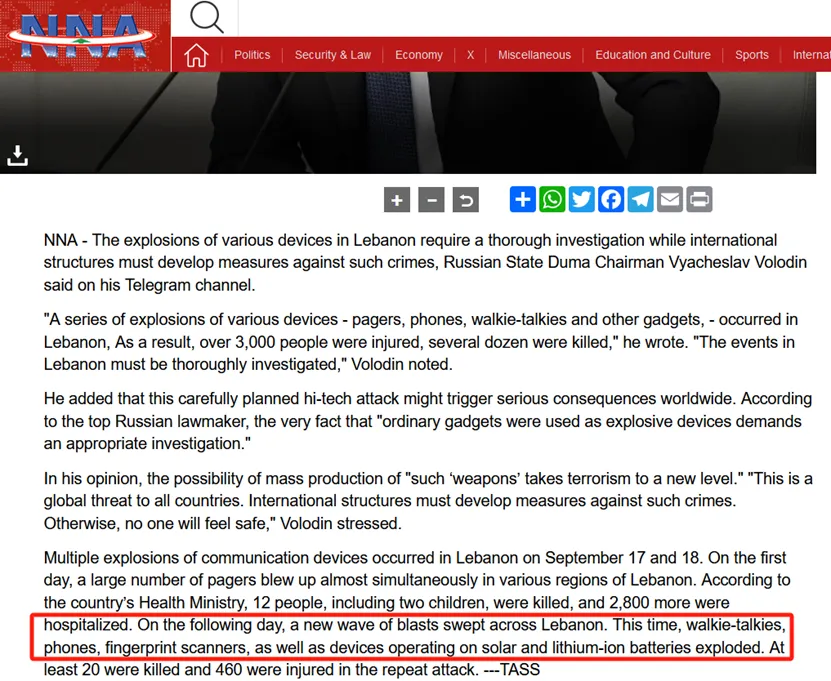
Caption: Relevant report by the National News Agency of Lebanon
Source: NNA
Lebanon’s National News Agency (NNA) reported that a new wave of explosions swept across Lebanon on September 18. This time, walkie-talkies, telephones, fingerprint scanners, and devices powered by solar energy and lithium-ion batteries all exploded. According to the agency’s report, rooftop solar systems in multiple areas of Beirut were detonated, though no further details were provided. It remains unclear whether the explosions were caused by explosives concealed within the solar panels or by some other form of external attack.
Although no fatalities have been reported, Lebanon’s National News Agency correspondent Zahraní wrote in his report: “A girl from the town of Al-Marwaniyah was injured when a solar-energy system at her home exploded.”
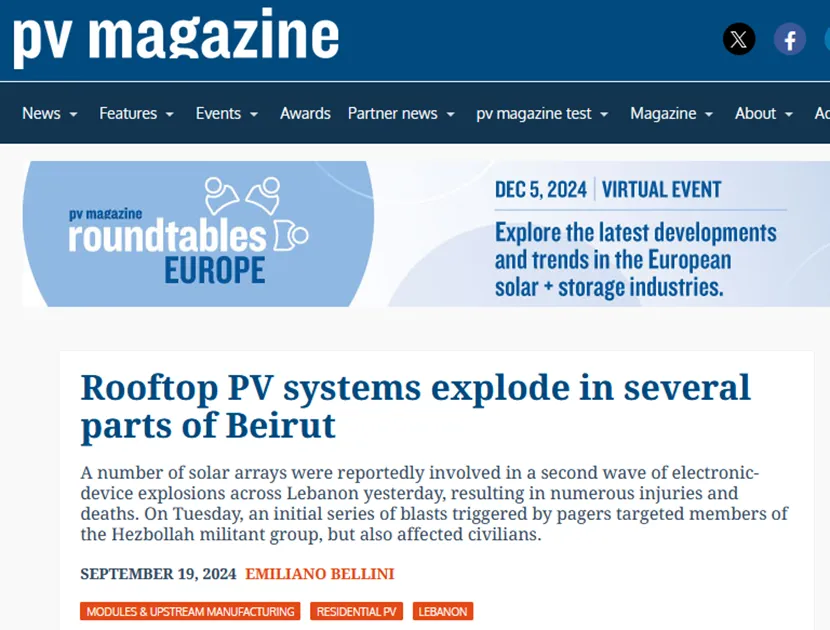
Caption: Photovoltaic Industry Media Report on a Rooftop PV System Explosion in Beirut
Source: PV Magazine
Meanwhile, Lebanese social media began circulating images of solar panels, fingerprint scanners, and other devices exploding.
One social media user wrote: “Lebanon: Damaged solar panels have sparked a severe electrical fire, injuring more than 500 people to date.” The accompanying image depicts a burning solar panel and a house on fire.
However, both Deutsche Welle (DW) and MisBar have debunked the image, confirming that it is unrelated to the recent explosions in Lebanon.
A reverse image search reveals that this is a composite cover consisting of two photographs. The image on the left shows burning solar panels and can be traced back to an X-post from February 2020. In that post, the National Fire Protection Association shared an article on the safety of photovoltaic systems alongside the image.
The photo on the right shows a burning house that occurred in December 2020. The fire took place in Canada, not Lebanon.
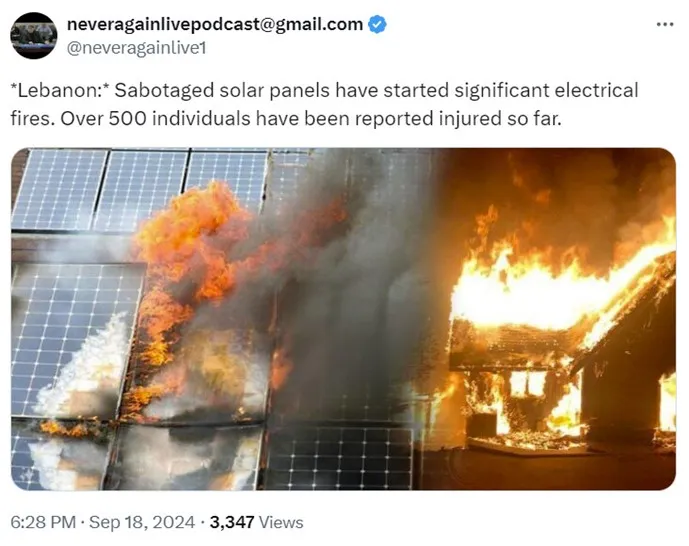
Caption: Lebanese social media posts about a solar panel explosion
Source: X
According to the National News Agency of Lebanon, household solar-energy systems have also exploded in several areas of Beirut and the south, including Nabatieh. However, these reports remain isolated incidents and have not been verified.
Philippe Khoury, CEO of Me-green, a company that provides end-to-end renewable energy solutions, and Pierre Khoury, Chairman of the Lebanese Energy Conservation Center (LCEC) under the Lebanese government’s National Energy Authority, told L’Orient Today that they have not received any reports of solar-energy-system explosions.
Georges Abboud, CEO and co-owner of Earth Technologies, said that despite this, many customers still called them after the incident to ask what steps they needed to take to protect themselves.
Abdul stated that lithium phosphate used in solar energy systems can cause fires, but not explosions. He believes that the explosion that occurred last Wednesday in Nabatieh, southern Lebanon, was likely not caused by the solar power system itself, but rather by nearby intercom equipment. He added that he has not heard of any other systems in other regions being either damaged in explosions or subjected to hacking attacks.
He said, “Unless there’s explosives in the solar system, it won’t explode.” He also noted that the likelihood of the system being hacked is extremely low, particularly because hackers would have to target each system individually.
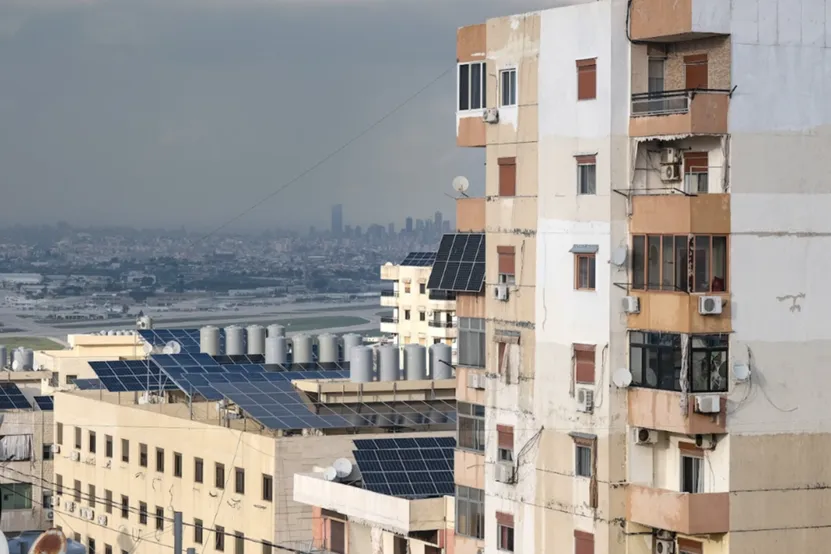
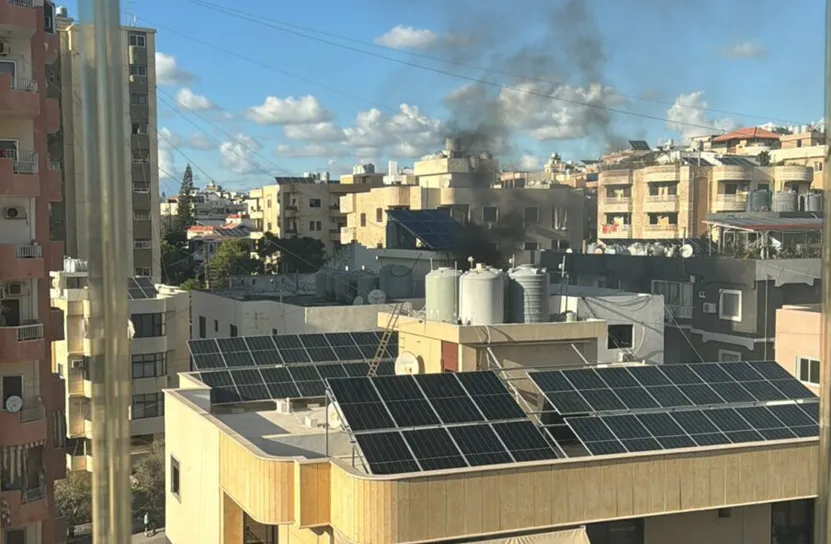
Caption: Solar panels on the roof of a residential building in Beirut, the capital of Lebanon.
Source: L'OrientToday
Ziad Makari, Lebanon’s caretaker Information Minister, told Reuters that panic was to be expected, noting that the attack represented “a new type of crime for Lebanese citizens,” as it struck at people’s homes, workplaces, and daily routines.
“There are plenty of rumors—walkie-talkies exploding, solar power systems exploding, televisions exploding, smartphones exploding.” He told Reuters: “There are a lot of lies… a lot of fake news, and none of it is helpful.”
Philip Curry and Pierre Curry cannot confirm whether solar power systems would explode in a deliberate attack. However, they recommend that, if people are concerned, they take additional precautionary measures by disconnecting the solar power system from the internet. Philip Curry stated: “This would significantly reduce the likelihood that someone could interfere with the system and manipulate its parameters to trigger an incident.”
Solar panels are typically connected to a photovoltaic inverter, which converts sunlight into electricity for use by the home’s electrical grid. The inverter can be Wi-Fi-enabled, allowing remote monitoring of system performance data via a mobile app or web portal.
“We should not panic,” Pierre Curie assured, adding that removing the SIM card connecting the system to the network is a simple security measure that can help mitigate the risk of hacking.

undefined
Navigation
Contact Us
Address: 2nd Floor, Building F, No. 21 Software Avenue, Yuhuatai District, Nanjing

Copyright © 2024 Nanjing Heben Mechanical & Electrical Equipment Technology Co., Ltd. Technical Support:China Enterprise Dynamics Nanjing Digital Business Card