




Stay informed about the latest updates
11
2025
-
02
Annual Shipments of Energy Storage Battery Cells Exceed 320 GWh: Shifts in the Three Major Segments
Author:
Looking back at the 2024 energy storage tendering and bidding market, battery cell centralized procurement, as an important subset, is typically conducted under both centralized and modular procurement models.
Looking back at the 2024 energy storage tendering and bidding market, battery cell centralized procurement, as an important subset, is typically conducted under both centralized and modular procurement models.
On the one hand, centralized procurement of battery cells and battery packs can reduce owners’ procurement costs, improve efficiency, and ensure supply-chain stability. These centralized procurement models also help increase market concentration, making it easier for large enterprises to capture market share.
On the other hand, cost optimization achieved through the mass production of 314 Ah battery cells in 2024 has accelerated the replacement of 280 Ah cells and, at the same time, has imposed even higher technical requirements.
In this regard, GGII Energy Storage has from From multiple perspectives, including procurement ratios, technical requirements, quality requirements, and certification requirements, With the aim of providing a more intuitive illustration of the changes in energy-storage battery-cell procurement demand in 2024.
First, changes in the procurement ratios and procuring entities for 280 Ah and 314 Ah energy storage battery cells.
Based on the procurement proportions of energy-storage battery cells in the first half of this year, 280 Ah cells remain the mainstream. Meanwhile, as major battery manufacturers accelerated mass production in the second quarter, 314 Ah cells have begun to be produced at scale. Property owners also launched large-scale procurement of 314 Ah energy storage battery cells in the second half of the year.
From the perspective of procurement proportion This year, two major state-owned enterprises—China Energy Conservation and Environmental Protection Group and China Electrical Equipment Group—each secured more than 70% of the single-bid share in the GWh-scale energy-storage battery-cell centralized procurement they launched.
Moreover, a single tender package awarded to China Energy Storage Equipment Group has reached as high as 11.1 GWh, marking the first procurement of 314 Ah energy storage battery cells exceeding the 10 GWh threshold this year.
From the perspective of the tendering entity This year, the first company to signal a centralized procurement of 314 Ah energy-storage battery cells was China Electrical Equipment Group, followed by other central state-owned enterprises and system integrators. According to incomplete statistics from GGII Energy Storage, In 2024, tenders for the procurement of 314 Ah energy storage battery cells have already exceeded 20 GWh.
From an industry perspective, the “Big Five and Small Six” have long been the dominant players in the energy-storage tendering and bidding market. Their procurement specifications set key industry technical benchmarks and reflect current market needs; they are also typically among the first to pioneer new applications, thereby bolstering integrators’ confidence in deploying 314 Ah energy-storage battery cells.
Second, the thresholds for performance and quality requirements are being raised.
Performance requirements In 2024, energy-storage tender specifications have raised the cycle-life requirement for 280 Ah and 314 Ah battery cells to over 6,000 cycles, with a calendar life of no less than 15 years, while also tightening efficiency requirements.
Notably, the newly issued GB/T 36276-2023 “Lithium-Ion Batteries for Power Energy Storage” stipulates that the single-cell energy efficiency shall be no less than 93% at 25°C, while the initial charge–discharge energy efficiencies of battery modules and battery clusters shall be no less than 94% and 95%, respectively.
From a system-level perspective, the GB/T 44026-2024 Technical Specification for Prefabricated Cabin-Type Lithium-Ion Battery Energy Storage Systems stipulates that, under ambient conditions (25°C), the DC cabin shall achieve a charge–discharge energy efficiency of no less than 88%, while the AC cabin shall achieve a charge–discharge energy efficiency of no less than 83%.
Under the new national standard, battery cell manufacturers are also extensively exploring the balance between economic benefits and safety thresholds.
HaoPeng Energy Storage, which also achieved mass production of 314 Ah battery cells in 2024, stated When certain market segments require battery cells to operate at a 0.5P charge rate, energy efficiency must be boosted to above 94.5% to enhance economic returns. This trend is prompting battery-cell manufacturers to place greater emphasis on cost-effectiveness, potentially at the expense of safety performance.
Moreover, HaoPeng argues that, under the winding process, increasing the energy efficiency of the 314 Ah cell from 94% to over 94.5% will raise the cell’s maximum temperature during overcharge and thermal runaway by 30°C to 50°C, thereby substantially increasing the cost of system-level safety design measures aimed at preventing thermal runaway and fire.
However, as the market continues to mature and gain wider adoption, HaoPeng believes that the industry will increasingly prioritize raising the safety thresholds of battery cells.
Meanwhile, with the implementation of GB 36276-2023, the requirements for external short-circuit protection have been tightened, thereby ensuring the absolute safety of battery cells under external short-circuit conditions.
Therefore, Hao Peng stated that, in the future, the 314 Ah battery cell will require more precise consideration of overcurrent design in its structural configuration. While ensuring safety, minimize the impact on charge–discharge energy efficiency to the greatest extent possible.
In addition, some property owners have also initiated tendering for power-type energy storage systems and battery cells. Power-type energy storage products are primarily used in applications such as grid frequency regulation, load leveling and energy recovery, and voltage sag mitigation. With the increasing penetration of renewable energy into the grid and ongoing power market reforms, the demand for rate-based energy storage solutions has become increasingly clear.
On January 17, the winning bidder for the Southern Power Grid Energy Storage Company’s 2023–2024 framework procurement project for energy storage power station equipment was announced. The tender included a framework procurement requirement for 1P battery energy storage systems, which was awarded to Zhiguang Energy Storage.
From an industry perspective, This procurement also marks the first time that 1P energy storage battery systems have been specified in a centralized power procurement. ( Previously, the concept of 1C energy storage batteries also existed.
In April, China Huadian Corporation issued a tender announcement for the procurement of a lithium iron phosphate electrochemical energy storage system for the Shuangfeng Huanggang Wind Power Project in Yifeng, Jiangxi Province. The scope of the tender covers a 15 MW/15 MWh lithium iron phosphate electrochemical energy storage system, with a battery charge–discharge rate of 1C and a nominal single-cell capacity of ≥280 Ah.
On November 28, Zhongchu Technology issued a tender announcement for the 2025 battery-cell framework procurement, with Package 2 calling for the purchase of 1 GWh of 1C battery cells in 2025.
Regarding quality requirements , some central state-owned enterprises have already begun to explicitly stipulate requirements for battery production dates. To a certain extent, this has prevented expired and overstocked batteries from circulating in the market.
In the 2025–2026 energy storage system tender announcement issued by Power Construction Corporation, The battery production date shall not be more than three months earlier than the project’s actual delivery date. The performance and parameters of the battery (cell) shall comply with the national quality standards in effect during the project implementation phase.
According to data from GGII, China’s planned lithium-battery production capacity in 2024 is approximately 590 GWh, a nearly 60% decline from 2023. Amid this supply-demand imbalance, battery-cell manufacturers are adopting a more cautious approach to commissioning new production facilities.
From the perspective of battery-cell manufacturers’ production rhythms, a three-month lead time from production to delivery both constrains companies’ ability to fulfill contracts using existing inventory and serves as a screening mechanism, favoring only those firms that can rapidly achieve substantial-scale mass production within a short timeframe.
Third, the procurement of energy-storage battery cells has created a demand for overseas certifications.
In a procurement tender nearing year-end, certification for exporting 314 Ah energy storage battery cells was explicitly required.
On December 24, Jiangxi Xingneng Equipment Technology Development Co., Ltd., a company controlled by Zhejiang Yaoning Technology Group, issued a tender announcement for its 2025 centralized procurement project of energy-storage system components (battery cells), with a total procurement volume of 4 GWh of 280 Ah and 314 Ah battery cells.
The tender requirements also stipulate that battery cells certified to IEC 62619, UL 1973, UL 9540A, and UN 38.3 shall be given priority in the shortlisting process.
It is worth noting that IEC, UL, and UN certifications are all overseas certification requirements and represent critical performance indicators; however, battery cell manufacturers often face the challenge of lengthy certification timelines.
Among these, the UL certification process in North America typically takes 8–16 business weeks, while the CE certification in Europe takes 3–6 business weeks; both are core safety certifications for market entry in overseas markets. In addition, lithium-ion energy storage battery cells seeking to enter international markets must also obtain other certifications and undergo related assessments, such as the UN 38.3 test for lithium batteries and transport compliance evaluations, further extending the scope of compliance requirements for global expansion.
In 2024, in addition to battery-cell manufacturers securing orders from overseas system integrators, domestic system integrators are also actively exploring opportunities to expand internationally, thereby driving ongoing changes in domestic centralized procurement requirements for battery cells.
According to incomplete statistics from GGII Energy Storage, as of the end of October, more than 52 GWh of energy-storage battery orders had been placed for export. Leading battery manufacturers such as CATL, Haichen Energy Storage, Ruipu Lanjun, EVE Energy, Chunan New Energy, and Gotion High-Tech have all secured overseas orders.
According to incomplete statistics from GGII Energy Storage, the following tenders this year have specified procurement requirements for energy-storage battery cells with capacities of ≥280 Ah and 314 Ah:
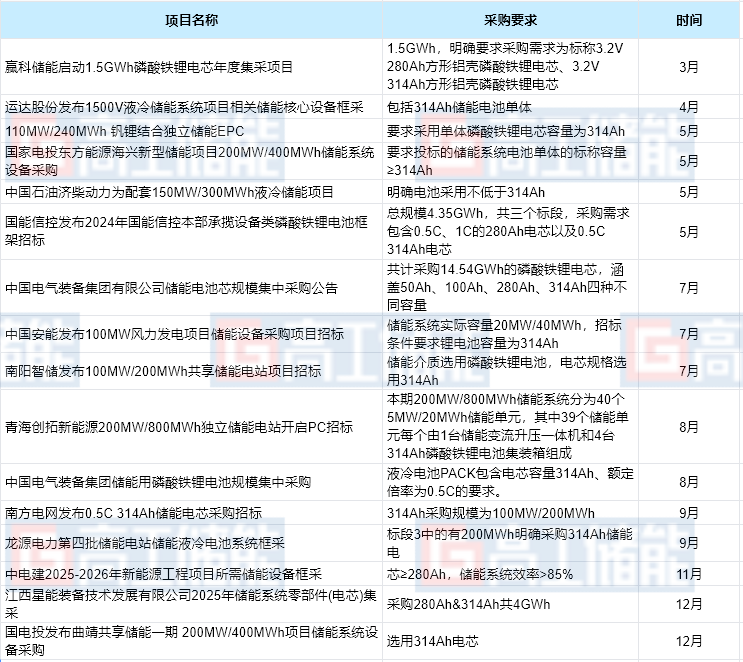
(For incomplete statistics*)
Source: GGII Energy Storage

undefined
Navigation
Contact Us
Address: 2nd Floor, Building F, No. 21 Software Avenue, Yuhuatai District, Nanjing

Copyright © 2024 Nanjing Heben Mechanical & Electrical Equipment Technology Co., Ltd. Technical Support:China Enterprise Dynamics Nanjing Digital Business Card